

Dubai Real Estate Market Trends June 2026: Prices Cool After a Record Q1
Dubai Real Estate Market Trends June 2026: Prices, Rents and Forecast
Last updated: June 2026
Quick answer: Dubai's property market in June 2026 is in a measured rebalancing phase. After a record first quarter of AED 252 billion in transactions, a regional geopolitical shock in March cooled sentiment, and prices and rents have softened in many communities since. The latest ValuStrat index showed values still up 8.9% year-on-year but down 5.9% in a single month, the first monthly decline since the post-pandemic recovery began. For buyers, this is shifting from a seller's market toward a more balanced one, with room to negotiate and a clear focus on quality and location.
This is the monthly companion to our pillar on Dubai real estate trends for 2026. Full June transaction totals from the Dubai Land Department publish in early July, so the figures below cover the latest verified data through Q1, May, and early June 2026.
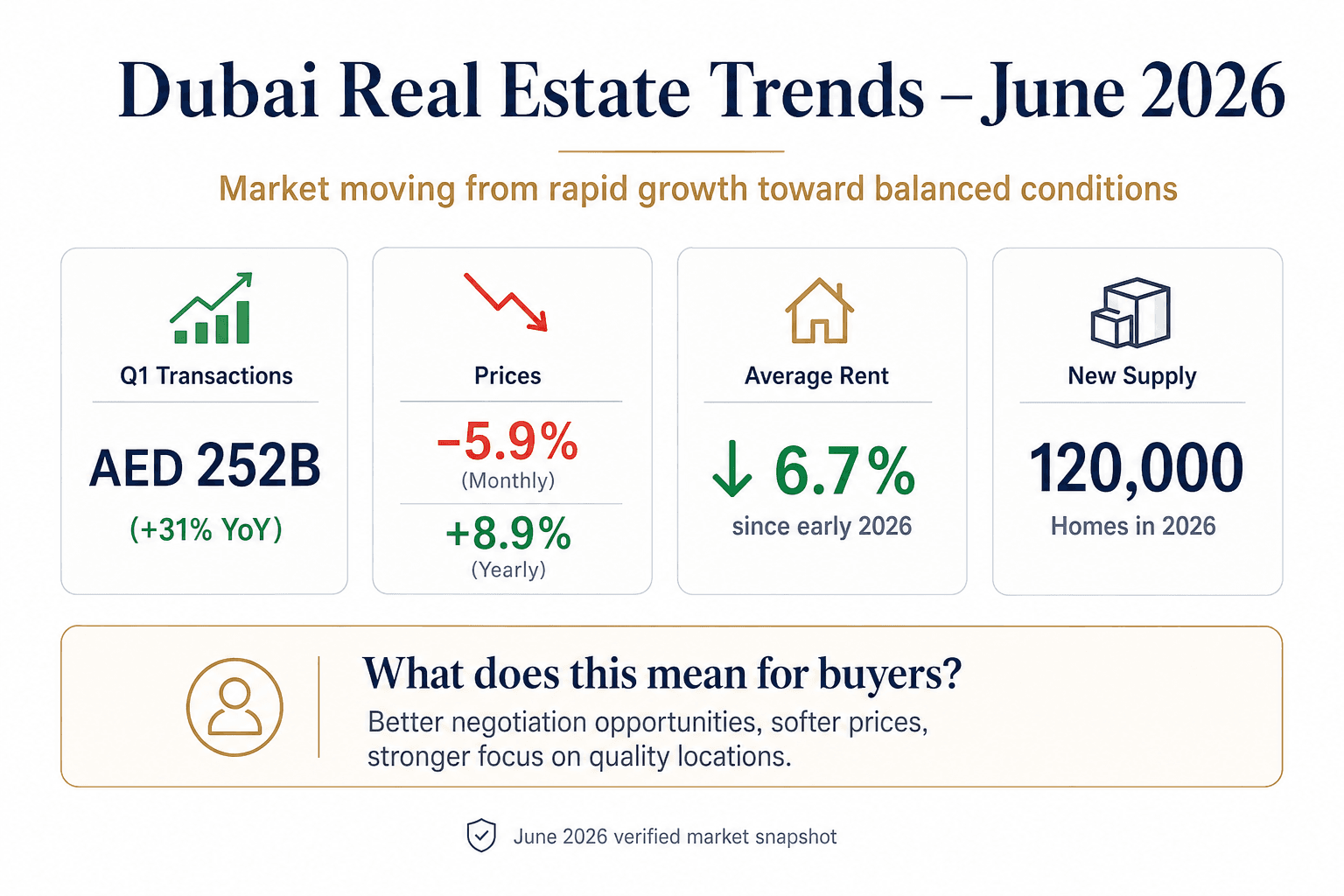
June 2026 at a glance
- Q1 2026 transactions: AED 252 billion, up 31% year-on-year in value and 6% in volume, across 60,303 transactions (Dubai Land Department).
- Foreign investment in Q1: AED 148.35 billion, up 26%, with 29,312 first-time investors entering the market (Dubai Land Department).
- May 2026 transactions: AED 40.63 billion across 12,879 deals, down 37.5% from April and 49.1% lower than May 2025 (data via The Real Estate Report, reported by Gulf Business).
- Prices (ValuStrat VPI, March 2026): down 5.9% month-on-month, the first monthly drop of the cycle, but still up 8.9% year-on-year.
- Rents: average Dubai rents fell around 6.7% between early 2026 and April, with some prime areas down close to 15% (Property Finder).
- Average price per sq ft (Jan to early June 2026): apartments around AED 1,969, villas around AED 2,241 (Property Monitor).
- Rental yields: around 6.57% citywide, with apartments up to 7.08% (REIDIN, April 2026).
- Supply: roughly 120,000 new homes scheduled for handover in 2026.
Dubai property prices June 2026: the correction explained
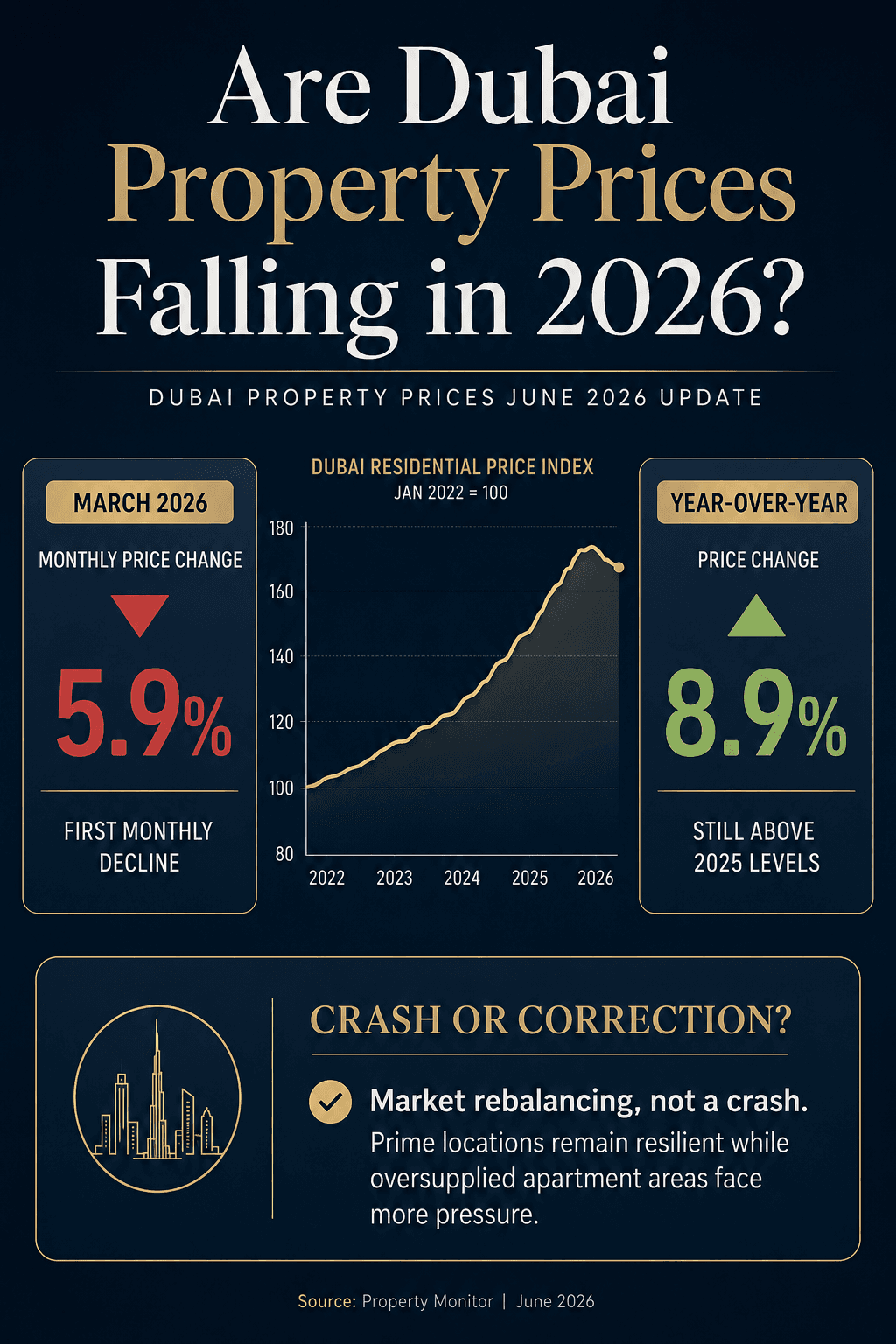
The headline shift in 2026 is that prices have started to cool after a long run of gains. According to ValuStrat, whose price index tracks more than 70 Dubai communities, the benchmark fell to 229.2 points in March 2026, a 5.9% monthly drop and the first monthly decline since the post-pandemic recovery began. Values still sat 8.9% higher than a year earlier, so this is a slowdown in growth rather than a collapse.
The pullback was broad. ValuStrat reported villa values down 5.8% and apartment values down 6.3% month-on-month, with the steepest villa declines in Arabian Ranches Phase 2, down 11.5%, and Dubai Hills Estate, down 10.8%. REIDIN data told a similar story: its Dubai residential sales price index slipped 1.76% month-on-month in April while staying 6.09% higher year-on-year, with villas still outperforming apartments over the full year.
Put simply, Dubai is moving into what analysts increasingly call a two-speed market. Prime, low-supply communities are holding up better, while apartment-heavy areas with large pipelines of new stock are seeing more pressure.
What triggered the slowdown
The cooling was driven by a mix of one-off and structural factors. A regional geopolitical shock in March 2026 hit sentiment hard. Goldman Sachs analysis cited by Fortune found UAE transaction volumes fell 37% year-on-year in the first 12 days of March and 49% month-on-month, while off-plan deals dropped 21% month-on-month to 9,368 transactions. ValuStrat also pointed to the timing of Ramadan and Eid, more remote working, and adverse weather as contributors to softer activity.
Underneath the short-term noise sits a longer story. Dubai residential prices rose roughly 60% between 2022 and early 2025, so some cooling was widely expected. Fitch had already forecast a correction of around 15% spread across July 2025 to the end of 2026, and warned the large delivery pipeline could deepen it. The slowdown carried into May, when total transactions reached AED 40.63 billion, down 37.5% from April and 49.1% below May 2025, with activity increasingly concentrated in off-plan launches and land deals rather than broad secondary-market turnover. The takeaway is not panic. It is that the market is normalising after an exceptional run, and selectivity now matters more than momentum.
Dubai rental market June 2026: tenants gain leverage
Rents are softening alongside prices, which is a meaningful shift after two years of landlords holding the upper hand. Property Finder data shows average Dubai rents fell around 6.7% between the start of 2026 and April. Some of the most sought-after neighbourhoods, including Downtown Dubai, Palm Jumeirah and Jumeirah Lake Towers, saw rental declines closer to 15%.
Rental movements usually lag capital values, so further easing is possible through the second half of the year. For investors, yields remain healthy: REIDIN put Dubai residential rental yields at around 6.57% in April 2026, with apartments reaching as high as 7.08%, comfortably ahead of mature markets like London or New York. You can estimate returns on a specific property with our Dubai rental yield calculator.
To improve rental access, the Dubai Land Department launched its Flexi Rent initiative in late June 2026, aimed at making rental payments more flexible and the leasing market more accessible.
Where prices stand by area
Average prices vary widely by community and property type. Based on Property Monitor data covering January to early June 2026, apartments averaged around AED 1,969 per sq ft and villas around AED 2,241 per sq ft across Dubai. Mid-market communities sit well below that: Jumeirah Village Circle averaged around AED 1,510 per sq ft, one reason it remains popular with yield-focused investors.
Prime waterfront and branded stock continues to command a large premium, with Palm Jumeirah, Downtown Dubai and Dubai Marina among the highest priced communities in the emirate. Value entry points remain in Dubai South, Dubailand and other southern growth corridors.
Is June 2026 a good time to buy in Dubai?
For the right buyer, the current phase has clear advantages. Negotiation is back on the table, sellers are more realistic, and there are fewer bidding wars than in 2024 and early 2025. Buyers willing to focus on quality, location and credible developers are in a stronger position than they have been in years.
The caution is around oversupplied, apartment-heavy areas and speculative off-plan stock, where price softening has been sharpest. Off-plan secondary apartments were reported trading 10% to 15% below original values in some cases. Long-term, the picture stays constructive: ValuStrat still forecasts citywide capital values to rise about 10% across 2026, with villas leading. Government support is also active, with Dubai's expanded First-Time Home Buyer Program passing AED 5 billion in sales and now spanning 22 developers and 5 banks.
If you are buying from abroad, read our guide on how safe it is to buy property in Dubai before committing.
Frequently asked questions
Are Dubai property prices falling in 2026? Prices have softened since March 2026 after a strong run. ValuStrat recorded a 5.9% monthly drop in March, the first of the cycle, though values stayed 8.9% higher year-on-year. Analysts describe it as a measured correction and rebalancing, not a crash.
Why did the Dubai market slow down in 2026? A regional geopolitical shock in March hit sentiment, alongside the timing of Ramadan and Eid, more remote working, and a large pipeline of new supply. Goldman Sachs reported UAE transaction volumes fell sharply in early March before the market began to stabilise.
What are rental yields in Dubai in June 2026? REIDIN put Dubai residential rental yields at around 6.57% in April 2026, with apartments reaching up to 7.08% and villas lower at around 4.54%.
Is it a good time to buy property in Dubai now? For buyers focused on quality and location, yes. Negotiating power has shifted toward buyers and prices are more reasonable. The main risk sits in oversupplied apartment areas and speculative off-plan units, so selectivity matters.
How much new supply is coming in 2026? Around 120,000 new residential units are scheduled for handover in Dubai during 2026, well above recent years, which is one reason prices are normalising.
How did Dubai's market perform in early 2026? Q1 2026 set a record for any first quarter, with AED 252 billion in transactions, up 31% year-on-year, and 29,312 new investors entering the market, according to the Dubai Land Department.
The boutique view
A rebalancing market rewards discipline over hype. As prices normalise and buyers grow more selective, location quality, build standards and developer credibility decide which assets hold value and which slide. That is exactly where a boutique, design-led approach earns its premium.
MSN Developments helps you read these shifts and act on them, identifying the locations, formats and strategies aligned with Dubai's 2026 fundamentals.
Table of Contents