
How to Invest in UAE Real Estate with Little Money in 2026
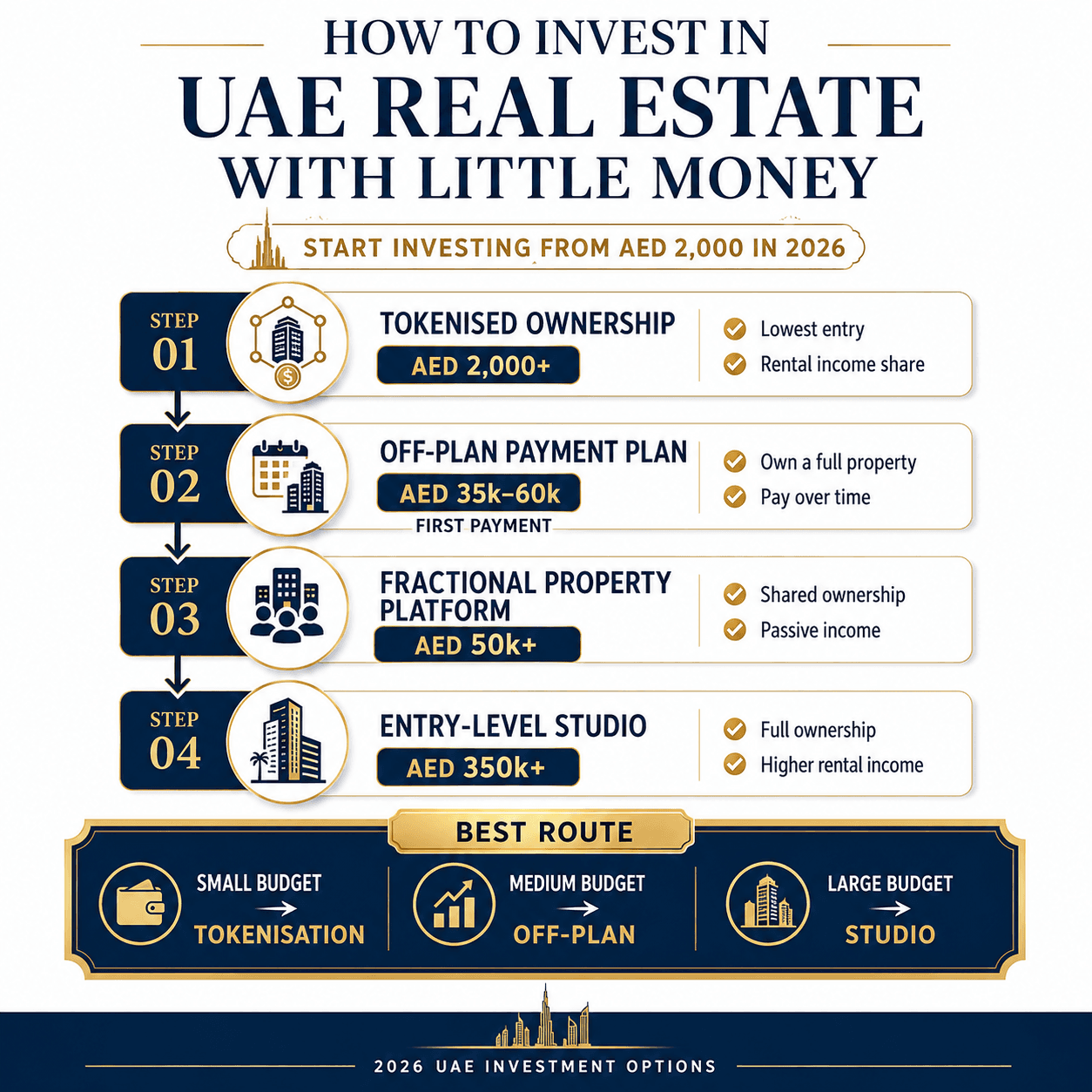
A small investment in UAE real estate now starts from as little as AED 2,000 through tokenised fractional ownership, from around AED 50,000 for a larger fractional stake, and from roughly AED 350,000 to 600,000 for an entry-level off-plan studio on a payment plan. You have four low-capital routes: tokenised property, off-plan payment plans, fractional platforms, and entry-level studios in high-yield communities. Each opens the market at a different price point, and each carries a different risk and return profile.
That is the short answer for anyone asking how to invest in Dubai real estate with little money. The rest of this guide breaks down every route, the exact entry costs, and where a small investment in Dubai works hardest in 2026.
Why Small-Capital Property Investment Changed in 2026
For years, entering Dubai property meant a full unit purchase and a large cash outlay. That barrier has fallen. Two developments reshaped real estate investment in the UAE for smaller budgets.
The first is regulated tokenisation. The Dubai Land Department launched its Real Estate Tokenisation Project pilot in March 2025 and moved to a second phase in February 2026, introducing secondary market resale under continued regulatory supervision. Through the DLD-backed platform, investors can own fractional shares of Dubai property starting at around AED 2,000, with the model regulated jointly by DLD and VARA. RealestateclubdubaiTulpartax
The second is the maturing of developer payment plans. Off-plan launches now open at booking amounts as low as 5 to 20 percent, with the balance spread across construction and, on many projects, beyond handover. Together these mean a first property position is reachable with capital that once covered only the transfer fee.
For the wider market case behind these routes, see our 2026 market guide on why invest in Dubai real estate.
The Four Routes to a Small Investment in UAE Real Estate
Each route below opens the market at a different budget. Match the route to the capital you hold and the involvement you want.
Route 1: Tokenised Fractional Ownership (from ~AED 2,000)
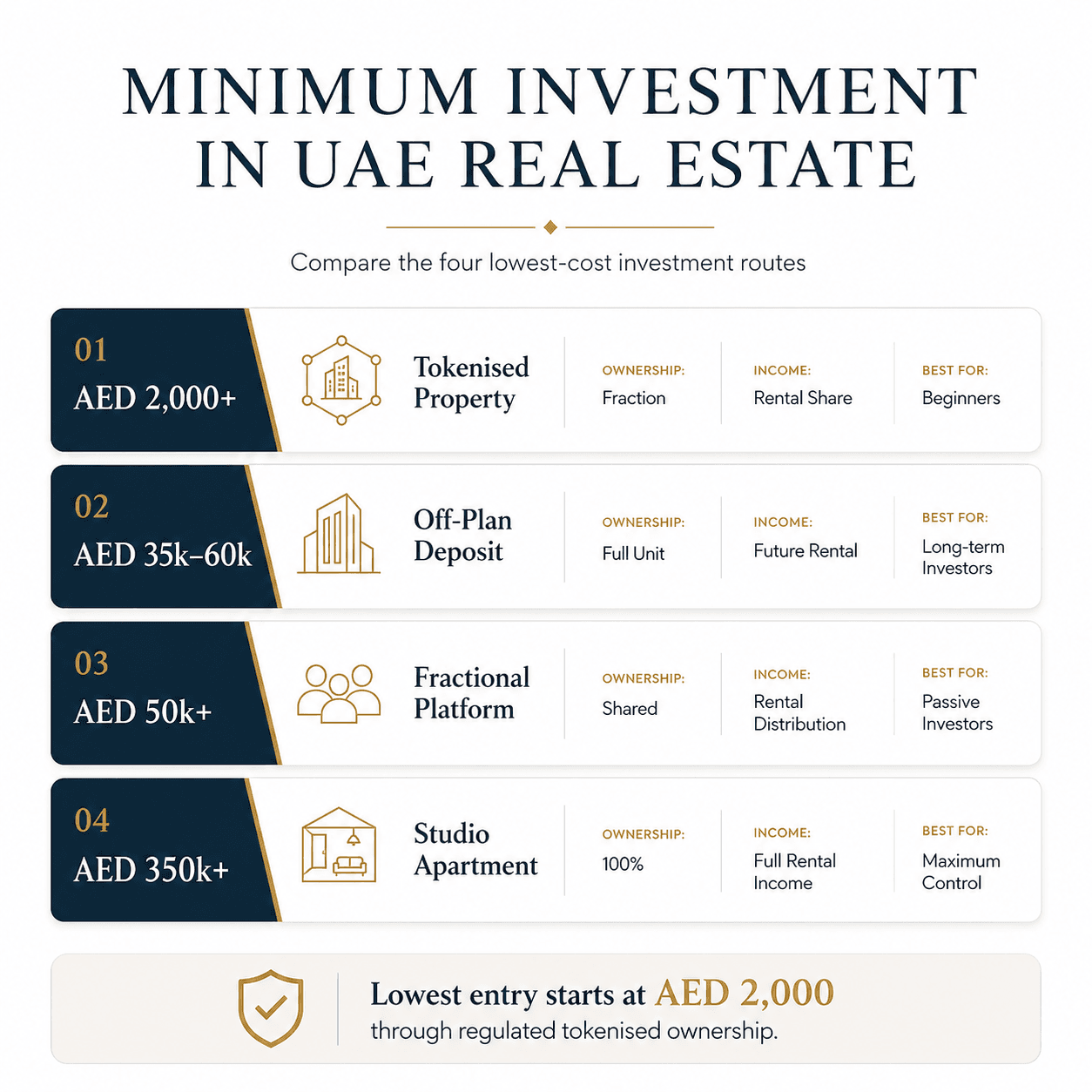
Tokenisation converts a property into digital shares recorded on a blockchain-linked registry. You buy a fraction, earn a proportionate share of rental income, and hold a stake tied to the property's value.
- Entry point: from around AED 2,000 on the DLD-backed platform
- Regulation: supervised by DLD and VARA, with ownership recorded against the title registry
- Income: proportionate rental distributions
- Liquidity: a secondary market opened in Phase II, allowing resale of tokens
- Best for: first-time investors testing the market with minimal capital
This is the lowest-cost answer to small investment in Dubai available in 2026, and the closest thing the market offers to buying property the way you buy a listed share. The tradeoff: you hold a fractional interest rather than a whole asset, so control over the property sits with the structure rather than with you.
Route 2: Off-Plan Payment Plans (from ~AED 350,000 total, low first payment)
Buying off-plan means purchasing during construction and paying in stages. The appeal for a small budget sits in the payment structure rather than the total price.
- First payment: commonly 5 to 20 percent of the unit value
- During construction: instalments tied to building milestones
- Post-handover plans: a portion paid across 2 to 5 years after you receive the keys
- Best for: investors who can commit a modest amount now and fund the rest from income or savings over time
On an entry-level studio in an emerging community, a 10 percent first payment can mean an initial outlay of AED 35,000 to 60,000 rather than the full price upfront. This is the route most first-time buyers use, and it pairs a small entry with ownership of a whole unit. Buying off-plan directly from a boutique residential developer in the UAE also removes the secondary-market commission, which keeps more of your capital in the asset.
Route 3: Fractional Investment Platforms (from ~AED 50,000)
Separate from DLD tokenisation, several licensed platforms let multiple investors co-own a whole property, with each holding a registered share.
- Entry point: commonly from around AED 50,000 depending on the platform
- Structure: the property sits in a special-purpose vehicle, and you own shares in that vehicle
- Income: rental distributions net of platform and management fees
- Best for: investors wanting a larger stake than tokens allow while keeping capital modest
Confirm the platform's licensing before committing, since the protections depend entirely on the regulated structure sitting behind the offer.
Route 4: Entry-Level Studios in High-Yield Communities (from ~AED 350,000 to 600,000)
For investors able to fund a whole unit at the lower end of the market, entry-level studios in yield-focused communities deliver rental income from a single, wholly owned asset.
- Entry point: studios from roughly AED 350,000 to 600,000 in emerging areas
- Income: full rental yield, among the highest gross returns in the market for well-chosen units
- Best for: investors who want a whole asset and the control that comes with it
This is where the best small investment in UAE real estate often lands for buyers with AED 350,000 or more, because a wholly owned studio in a strong rental area combines a manageable entry with complete ownership. For the specific communities that suit this route, see our full breakdown of where to invest in Dubai by area and budget.
Small Investment in UAE Real Estate for Expats and Foreigners
A common question runs underneath all of this: do these routes work for people who live abroad or hold a foreign passport? Yes. A small investment in UAE real estate for expats and a small investment in UAE real estate for foreigners follow the same rules as any foreign purchase.
- Nationality: any nationality may own inside designated freehold areas, with no restriction
- Residency: ownership requires no UAE visa, and the entire process can complete remotely
- Age: buyers must be 21 or above
- Tokenised routes: open to residents and non-residents who pass identity and source-of-funds checks
Property investment in Dubai for foreigners carries the same protections at every budget level: title recorded by the Dubai Land Department, escrow on off-plan payments, and regulated structures behind tokenised offers. For the full ownership picture, read our guide to Dubai property law for foreigners, which covers what your title gives you and how long it lasts.
Using a Small Investment in UAE Real Estate Calculator
Before committing, run the numbers. A small investment in UAE real estate calculator helps you model three figures that decide whether a route works for your budget.
- Total capital required at entry: first payment plus closing costs
- Net rental yield: gross yield minus service charges, management fees, and expected vacancy
- Return over your holding period: rental income plus any capital appreciation, against your total outlay
The variable that most often surprises new investors is the service charge, levied per square foot annually and varying widely between buildings. Two studios with identical rents can deliver materially different net returns once this charge applies. Always request the current rate before you commit.
We are building a dedicated entry-cost and yield calculator for exactly this purpose. In the meantime, our team can run the figures for any budget you have in mind.
Where a Small Investment Works Hardest
The best small investment in UAE real estate depends on which route you choose, and each route points to a different area strategy.
- For tokenised and fractional routes: the platform selects the property, so your job is to check the asset's location, its yield history, and the structure's licensing.
- For off-plan on a payment plan: emerging communities such as Dubai South, Arjan, Dubai Sports City, and International City combine low entry prices with steady rental demand.
- For a wholly owned studio: high-yield communities with low service charges deliver the strongest net returns, since the charge weighs heaviest on smaller units.
Timing matters alongside area. Our analysis of whether it is a good time to buy property in Dubai sets out the current price and yield data behind these community choices.
The Costs to Budget Beyond the Purchase
A small entry still carries transaction costs. Budget for these on any whole-unit purchase.
- DLD transfer fee: 4 percent of the purchase price plus administrative charges
- Registration trustee fee: a fixed amount tiered by property value
- Agency commission: typically 2 percent plus VAT on secondary-market purchases
- Mortgage registration: 0.25 percent of the loan where financing applies
- Service charges: annual, per square foot, varying by community
On tokenised and fractional routes, these costs sit inside the platform structure and appear as fees rather than separate line items, so read the fee schedule closely before committing.
Matching Route to Budget: A Quick Summary
- AED 2,000 to 50,000: tokenised fractional ownership through the DLD-backed platform
- AED 35,000 to 60,000 as a first payment: off-plan studio on a payment plan, funding the balance over construction
- From AED 50,000: a larger share through a licensed fractional platform
- From AED 350,000 to 600,000: a wholly owned entry-level studio in a high-yield community
Every route above is reachable with capital that once covered only the fees on a full purchase. That shift is the real story of low-capital real estate investment in UAE in 2026.
Frequently Asked Questions
What is the minimum investment in real estate in Dubai?
The minimum entry point in 2026 starts from around AED 2,000 through the Dubai Land Department's tokenised fractional ownership platform, which lets investors own a share of a property regulated jointly by DLD and VARA. Licensed fractional platforms commonly start from around AED 50,000. For a wholly owned unit, entry-level studios on off-plan payment plans can begin with a first payment of AED 35,000 to 60,000, with the balance spread across construction.
How to earn $30,000 per month in Dubai from property?
Reaching roughly AED 110,000 per month in rental income requires a substantial portfolio rather than a single small investment. At a net rental yield of 6 to 8 percent, that income level implies invested capital in the region of AED 16 million to 22 million across multiple units. A small investor reaches it over time by reinvesting rental income, using off-plan payment plans to acquire additional units, and compounding returns across a holding period of several years, rather than through any single entry-level purchase.
Where to invest a small amount of money in the UAE?
For property specifically, the strongest small-capital routes are tokenised fractional ownership from around AED 2,000, licensed fractional platforms from around AED 50,000, and entry-level off-plan studios in high-yield emerging communities such as Dubai South, Arjan, and International City. The right choice depends on how much control you want and how much capital you hold, with tokenisation offering the lowest entry and a wholly owned studio offering full ownership and complete rental income.
How to invest 2000 dirhams in UAE real estate?
AED 2,000 is enough to buy a fractional token on the Dubai Land Department's regulated tokenisation platform, which represents a share of a real property recorded against the title registry. You earn a proportionate share of the rental income, and a secondary market introduced in the project's second phase allows resale of the tokens. This is the single most accessible route into UAE property in 2026.
Will Dubai property prices go down in 2026?
Forecasts point to continued positive growth for the full year rather than a broad decline, with major analysts projecting citywide capital growth in the single-to-low-double digits and villas forecast to outperform apartments. Month-to-month corrections have occurred within that trend, with values easing in some months while annual growth stayed positive. The cash-heavy nature of Dubai transactions limits the forced-selling pressure that drives sharp corrections elsewhere. For current data and the full forecast picture, see our analysis of whether it is a good time to buy property in Dubai.
Can foreigners make a small investment in UAE real estate?
Yes. A small investment in UAE real estate for foreigners follows the same rules as any foreign purchase: any nationality may own inside designated freehold areas, ownership requires no UAE visa, and the process can complete remotely. Tokenised routes are open to residents and non-residents who pass identity and source-of-funds checks.
Is a small property investment in Dubai safe?
Each regulated route carries defined protections. Off-plan payments sit in DLD-supervised escrow released against construction milestones. Tokenised ownership is regulated jointly by DLD and VARA and recorded against the title registry. The key safeguard on any route is confirming the licensing and registration behind the offer before transferring funds.
Your Next Step
A small investment in Dubai property in 2026 is reachable from AED 2,000 through tokenisation, from a modest first payment through off-plan, and from AED 350,000 through a wholly owned studio. The route that fits you depends on your capital, your appetite for control, and your holding period.
MSN Developments works with investors at every entry point, from first fractional stakes to entry-level off-plan units. Speak with our team to match a route to the capital you have and the return you want.
Table of Contents