
Dubai Property Law for Foreigners: What Your Title Deed Gives You and How Long It Lasts
Dubai property law for foreigners grants a registered owner a permanent title with no expiry, held independently of any visa. The deed carries six enforceable rights: sell, lease, mortgage, gift, bequeath, and modify. Title survives the loss of UAE residency, transfers to heirs, and holds regardless of how long the owner spends outside the country. The mechanism that decides what happens to it after death is a registered will rather than the title itself.
This guide covers ownership rights and their durability over time. For eligibility, designated areas, freehold definitions, and the buying process, read our published guide on whether foreigners can buy property in Dubai. For the statutory framework covering tenancy, escrow, and building codes, see Dubai real estate laws and regulations.
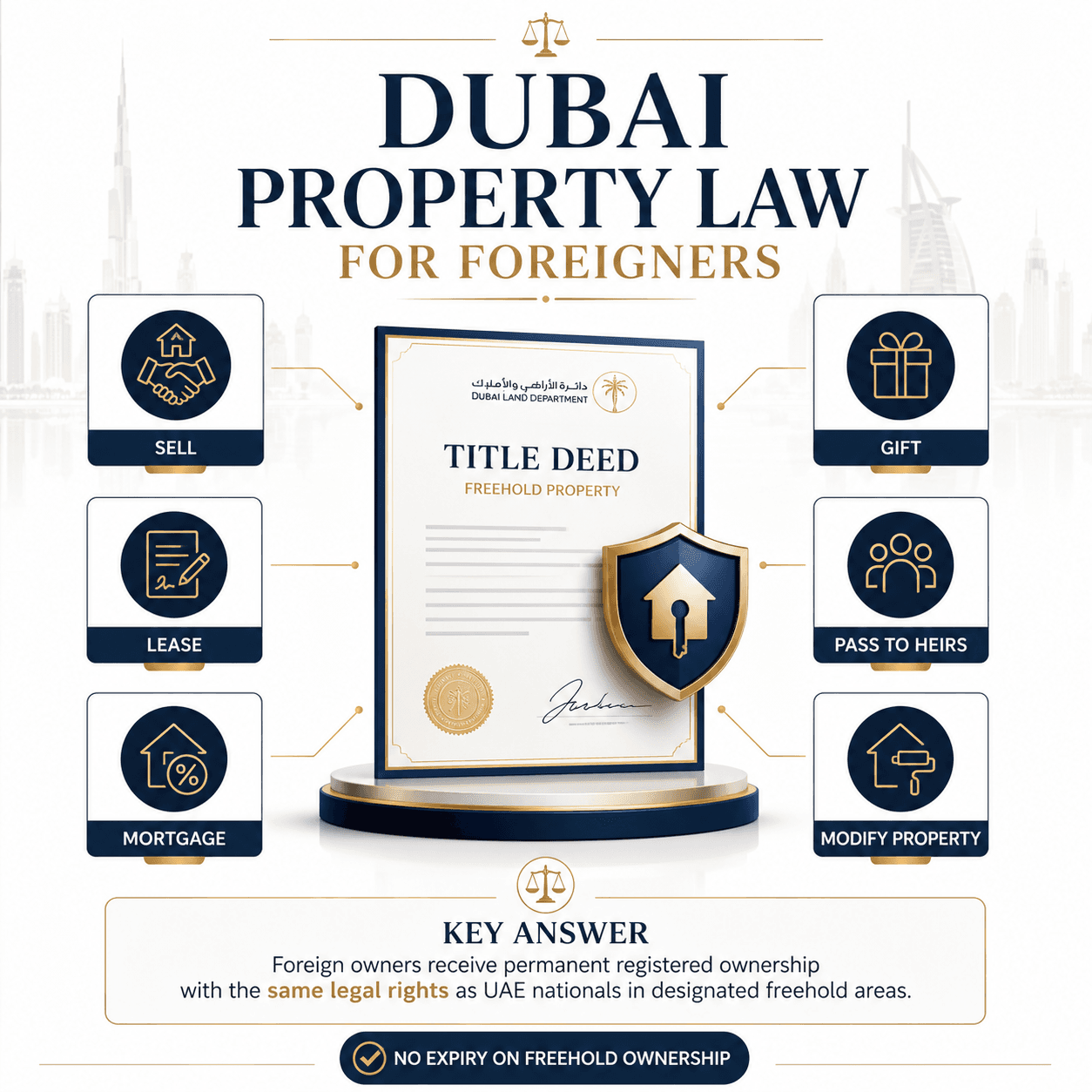
The Six Rights a Foreign-Held Title Deed Confers
Dubai property laws treat a registered foreign owner and a registered national owner identically on the rights attached to the deed. Once DLD records the transfer, the owner holds:
- The right to sell at any time, to any eligible buyer, with no minimum holding period and no government approval requirement
- The right to lease the property and retain the income, with no tax applied to rent received
- The right to mortgage the property, with the charge registered against the title at DLD
- The right to gift the property, including transfers between family members, processed as a registered gift transfer
- The right to bequeath the property to named heirs, subject to the succession mechanism covered below
- The right to modify the property within building regulations and owner association rules
Laws in Dubai for foreigners contain no separate ownership class, no reduced bundle of rights, and no requirement for a local partner or nominee. A woman holds the same rights as a man, and a single owner holds the same rights as a married one, with no guardian or spousal approval required.
Ownership Runs Independently of Your Visa
This is the most consequential point in Dubai property law for foreigners and the one most often misunderstood at purchase.
Property ownership and residency operate under two separate authorities with two separate legal systems. DLD registers the property. Immigration authorities issue the visa. Neither system controls the other.
The practical consequences:
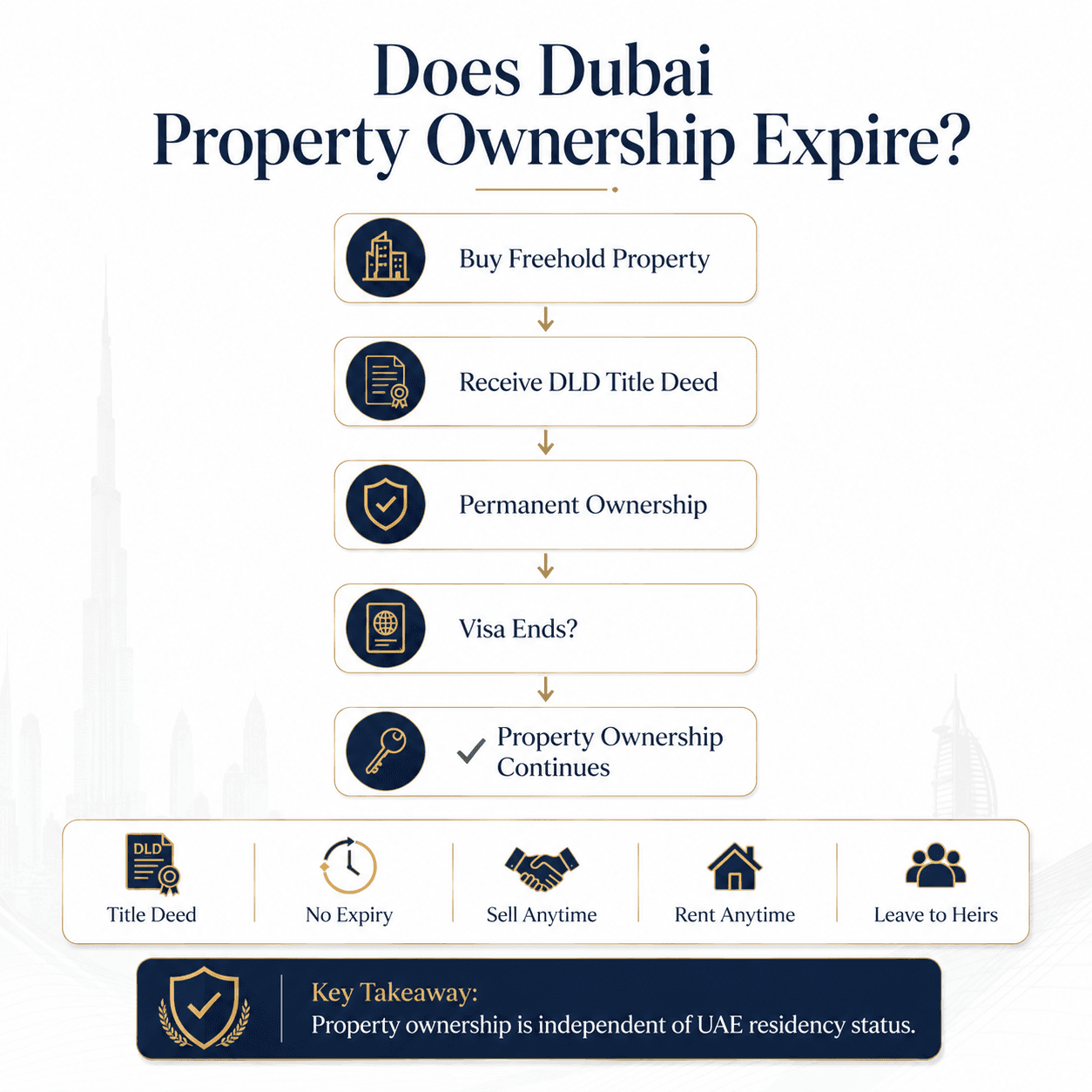
- Losing a UAE residence visa has no effect on a registered title. The owner remains the owner, may continue leasing the property, and may sell at any time.
- Ownership creates eligibility to apply for residency rather than granting it. The application is a separate process with its own thresholds and conditions, covered in our guide to Golden Residency in the UAE.
- A visa refusal or expiry triggers no forced sale. There is no statutory disposal requirement attached to visa status.
- Time spent outside the UAE has no bearing on title. An owner living permanently abroad holds the same rights as a resident owner.
Can we buy property in Dubai permanently? Yes, where the purchase is freehold. The deed carries no expiry date, no renewal requirement, and no reversion to the state or the developer. The owner holds it until they sell, gift, or pass it on.
How Title Can Be Held: Individual, Joint, Company, Minor
Foreign buyers have four registration structures available, and the choice made at purchase becomes difficult to reverse without a fresh transfer and fresh fees.
- Sole ownership. The deed lists one name. Simplest to sell and mortgage, and the structure most commonly used for a first purchase.
- Joint ownership. Two or more owners registered with defined shares, which may be equal or unequal. Each share is separately transferable. Where a share is sold, co-owner consent requirements depend on the terms recorded at registration.
- Company ownership. Property held by a UAE-registered company or an approved offshore vehicle. Used where owners want succession to run through shares rather than through the property, or where multiple investors participate. The company must be of a type DLD accepts for property registration, which rules out many foreign incorporations.
- Ownership in a minor's name. Permitted, with the property registered to the child and managed by a guardian. Disposal before the child reaches majority requires court approval, which makes this structure slow to unwind.
Two points worth raising with a lawyer before signing. Company ownership changes how residency eligibility is assessed, since the property sits with the entity rather than the individual. And joint ownership between unmarried co-buyers benefits from a written agreement covering exit, since the deed records shares without recording intentions.
Buying and Holding From Abroad: Power of Attorney
A foreign owner can complete and manage every stage of ownership without entering the UAE, through a properly executed power of attorney.
- Execution. The POA is drafted, notarised in the owner's home country, legalised through the UAE embassy or apostille route depending on the country, then attested and translated in the UAE.
- Scope. DLD expects specific authority. A general POA often falls short, so the document should name the powers granted, such as purchase, sale, mortgage, registration, and receipt of funds.
- Validity. POAs carry expiry terms and remain revocable. Where a POA is used for a sale, DLD checks currency and scope at the point of transfer.
- Risk control. Grant the narrowest authority the transaction requires, and avoid open-ended authority to sell where the purpose is purchase only.
The same instrument supports ongoing management: signing tenancy contracts, appointing a property manager, and dealing with the owners association.
Inheritance and Succession: The Gap Most Foreign Owners Leave Open
This is the area with the largest consequences and the lowest awareness, and it sits outside anything covered on our other guides.
UAE law applies to immovable property located in the UAE. Where a foreign owner dies without a registered will covering the asset, succession over a Dubai property may be determined under UAE principles rather than the owner's home country rules. Home country wills and probate grants carry no automatic effect over UAE-registered property. During the period this is resolved, the property and any linked accounts may be frozen, leaving heirs with an asset they hold no access to.
Three established mechanisms address it:
- DIFC Wills Service Centre. Allows non-Muslim owners to register a will covering UAE assets, directing succession according to their chosen terms, with enforcement through DIFC Courts.
- Dubai Courts wills registration. An alternative registration route for non-Muslim owners.
- Company or trust structures. Holding property through an entity converts the question from property succession to share succession, governed by the entity's own rules.
For Muslim owners, UAE succession principles apply by default, and specialist advice matters where heirs sit across multiple jurisdictions.
Treat this as part of the purchase rather than something to handle later. Registering a will costs a fraction of what an unresolved estate costs heirs, and it takes days rather than months.
Divorce, Marital Claims, and Registered Title
A second long-tail question that rarely appears in buying guides.
The deed governs the legal position. Where a property is registered in one spouse's sole name, that person is the legal owner in the DLD register regardless of who contributed funds. A claim by the other spouse becomes a matter for the court hearing the divorce, and its outcome depends on which law that court applies.
Practical protections for couples buying together:
- Register both names with defined shares where both contribute
- Keep documentary evidence of contributions where the deed lists one name
- Record intentions in writing at purchase rather than reconstructing them later
Foreign couples should confirm which jurisdiction would hear a matrimonial claim over a UAE asset, since the answer varies with nationality, residency, and where the marriage was registered.
Acquiring Without Conventional Interest-Bearing Finance
Buyers seeking to buy property in Dubai without interest have two legal structures available, both widely used and both distinct from a conventional mortgage.
- Islamic home finance. UAE banks offer Sharia-compliant structures including Ijara, where the bank buys and leases the asset to the buyer with ownership transferring at the end of the term, and Murabaha, where the bank buys and resells at a disclosed mark-up paid in instalments. The legal relationship is sale or lease rather than a loan.
- Developer instalment plans. Off-plan purchases structured as staged payments across construction, with post-handover plans extending instalments beyond completion. These carry no separate interest charge, with pricing built into the headline value.
The choice carries a registration consequence worth knowing. Islamic structures may involve an intermediate transfer or a registered lease, which changes the documentation trail and can affect timing on a later sale. Confirm with the bank how title and any charge will appear on the register before signing.
For conventional mortgage eligibility, lending ratios, and documentation, see the financing section of our foreign buyer guide.
How to Buy Property in Dubai Without a Down Payment
Searches for how to buy property in Dubai without down payment deserve an honest answer. UAE mortgage regulation caps how much a bank may lend against a property, which means every financed purchase requires equity from the buyer. No legal route exists to a zero-equity purchase through a regulated lender.
What genuinely exists:
- Low booking amounts on off-plan launches, with the balance spread across the construction period
- Post-handover payment plans, moving a portion of the price into the years after the keys are handed over
- Developer-arranged completion finance, where the developer introduces a lender for the handover payment
Two cautions. Any offer described as 100 percent financing or zero cash entry should be verified against the developer's RERA registration and the project escrow account before a single transfer. And read the payment schedule alongside the headline price rather than in isolation, since extended plans and headline values move together.
Leasing the Property as a Non-Resident Owner
Can I buy property in Dubai and rent it out while living abroad? Yes. The right to lease is inherent in the registered title, requires no UAE visa, and the rental income carries no tax in the UAE. Non-resident owners commonly appoint a property manager to hold the operational relationship.
The tenancy itself is governed by Dubai's tenancy legislation, covering registration, permitted rent increases, notice periods, and short-term letting permits. Full detail sits in our guide to Dubai real estate laws and regulations.
Legal Exposures Specific to Foreign Owners
The risks of buying property in Dubai that sit in the legal layer are distinct from market and cost risks, and they are the ones a foreign owner is most likely to overlook.
- Structure mismatch. Buying through a company when residency was the objective, or in a minor's name when flexibility was, creates problems that require a fresh registered transfer to fix.
- Succession left unaddressed. Covered above, and the exposure with the longest tail.
- Source of funds and third-party payments. Anti-money-laundering checks apply to every transfer, and payments arriving from an account in a name other than the buyer's are commonly refused. Fund the purchase from an account matching the name that will appear on the deed.
- Power of attorney defects. A POA with insufficient scope, an expired term, or incomplete legalisation stops a transfer at the counter, often after other deadlines have been committed.
- Ownership form mismatch. Confirm that the interest recorded on the contract matches what was marketed, since freehold, leasehold, and usufruct carry materially different durations.
- Unlicensed intermediaries. Verify RERA registration for any broker and the licence for any developer before transferring funds.
- Currency and repatriation. The dirham is pegged to the US dollar, which removes one variable. Buyers funding from other currencies carry exchange exposure on the way in and on the way out.
Market and cost exposures, including handover timing, service charges, and supply cycles, are covered separately in our current Dubai buying conditions analysis.
Repatriating Rental Income and Sale Proceeds
The UAE applies no exchange controls and no restriction on moving funds out of the country. A foreign owner may transfer rental income and sale proceeds abroad in full.
Three points shape how smoothly that runs:
- Banking trail. Funds move faster where income and proceeds pass through a UAE account in the owner's name, with documentation linking them to the property.
- Home country obligations. Income earned in the UAE remains reportable in jurisdictions taxing worldwide income. The absence of UAE tax carries no effect on obligations elsewhere.
- Sale settlement. Proceeds are released at transfer through the registration trustee, which means account details should be confirmed well ahead of the transfer date.
Freehold Property in Abu Dhabi for Expats
Buyers researching freehold property in Abu Dhabi for expats buy decisions should treat it as a separate legal system rather than a variation on Dubai's.
Foreign ownership in Abu Dhabi is permitted inside designated investment zones, which include Al Reem Island, Yas Island, Saadiyat Island, Al Raha Beach, and Masdar City. Legislation passed in 2019 extended freehold title to foreign buyers within those zones, replacing the earlier position under which non-nationals held limited-term interests. Registration runs through the Abu Dhabi Real Estate Centre rather than DLD, and the emirate operates its own tenancy regime and its own dispute route.
The differences a Dubai owner should expect: fewer designated zones, a smaller secondary market, and separate registration processes that carry no read-across from a Dubai transaction.
Frequently Asked Questions
What rights does a foreign owner's title deed give in Dubai?
A registered title gives the owner the right to sell, lease, mortgage, gift, bequeath, and modify the property, on the same terms as a national owner. The deed carries no expiry date and requires no renewal. Rights are recorded on the Dubai Land Department register, which is the sole evidence of legal ownership.
Does a Dubai property title expire if your residence visa ends?
No. Ownership and residency operate under separate authorities and separate legal systems. Losing or ending a UAE residence visa leaves a registered freehold title untouched, with the owner free to continue leasing the property or to sell at any time.
Can we buy property in Dubai permanently?
Yes, where the purchase is freehold. The title has no expiry, no renewal requirement, and no reversion to the state or the developer. It passes to heirs where a valid succession mechanism is in place.
Who inherits a foreigner's property in Dubai?
UAE law applies to property located in the UAE, so a home country will carries no automatic effect over a Dubai title. Non-Muslim owners may register a will through the DIFC Wills Service Centre or Dubai Courts to direct succession under their chosen terms. Without a registered will, the estate may be determined under UAE principles and the asset may be frozen while that is resolved.
Can a foreigner buy property in Dubai without interest?
Yes, through Sharia-compliant bank structures such as Ijara and Murabaha, where the relationship is a lease or a sale at a disclosed mark-up rather than a loan, or through developer instalment plans that carry no separate interest charge. Confirm how title and any charge will appear on the DLD register before signing.
Is a zero down payment purchase possible in Dubai?
No. UAE mortgage regulation caps bank lending against a property, so every financed purchase requires buyer equity. Low booking amounts on off-plan launches and post-handover payment plans reduce the capital needed at entry, which is the closest genuine equivalent.
Can a foreigner own property in Saudi Arabia?
The position changed in January 2026. Foreign residents may own property within designated zones, and may additionally own one residential property outside those zones, with all acquisitions requiring registration. Property ownership in Saudi Arabia confers no residency or citizenship rights, which remain governed by separate immigration frameworks, which is the sharpest practical difference from the UAE position.
Can a foreign owner in Dubai rent the property out?
Yes. The right to lease is inherent in the registered title and requires no UAE visa, with rental income carrying no UAE tax. The tenancy itself follows Dubai's tenancy legislation on registration, rent increases, and notice periods.
What is the 3000 dirham rule in Dubai?
No AED 3,000 threshold exists within Dubai property law. The figure circulates in discussion of salary and sponsorship thresholds under UAE labour and immigration rules, which sit under different authorities and carry no bearing on property ownership. Eligibility for a foreign buyer turns on the designated area, the buyer's age, and DLD registration.
Can property in Dubai be registered in a child's name?
Yes. Property may be registered to a minor with a guardian managing it, though disposal before the child reaches majority requires court approval. This makes the structure slow to unwind and worth weighing against sole or joint ownership at purchase.
Owning With the Law on Your Side
Dubai gives foreign owners a stronger position than most comparable markets: permanent title, no nationality restriction, no property tax, free repatriation of proceeds, and a single centralised register. The owners who fare best are the ones who choose the holding structure deliberately at purchase and register a will soon after.
MSN Developments is a boutique residential developer in Dubai working with buyers across a wide range of nationalities. Speak with our team for a project-level review of ownership form, holding structure, and payment structure.
Table of Contents