

Dubai Real Estate Laws and Regulations: The Complete 2026 Framework
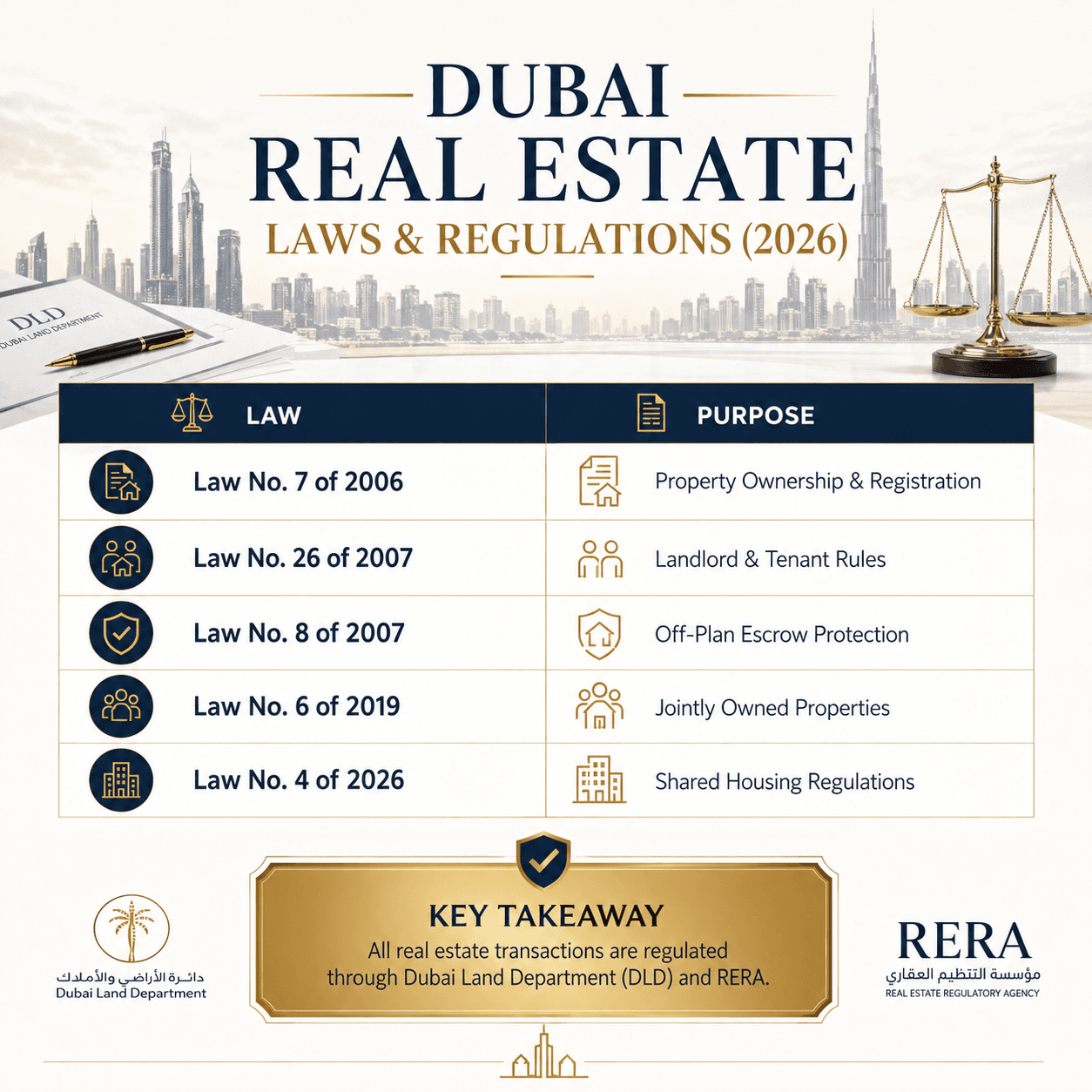
Dubai real estate laws and regulations are built on a small group of emirate-level laws administered by the Dubai Land Department and its regulatory arm, RERA. Law No. 7 of 2006 governs property registration and ownership eligibility. Law No. 26 of 2007, as amended by Law No. 33 of 2008, governs tenancy. Law No. 8 of 2007 governs off-plan escrow. Law No. 6 of 2019 governs jointly owned property and service charges. Together these define who may own, how ownership is recorded, how rents move, and how disputes are resolved.
This guide covers the full regulatory stack: ownership law, tenancy law, building codes, brokerage rules, and the 2026 updates. For the ownership rights of non-nationals specifically, read our dedicated guide to Dubai property law for foreigners.
Who Regulates Real Estate in Dubai
Four bodies carry regulatory authority over property in the emirate.
- Dubai Land Department (DLD): the government authority that registers every transaction, issues title deeds, and maintains the property register. Every sale, mortgage, and gift transfer passes through DLD.
- Real Estate Regulatory Agency (RERA): the regulatory arm of DLD, established under Law No. 16 of 2007. RERA licenses brokers and developers, supervises escrow accounts, publishes the rental index, and regulates owners associations.
- Rental Disputes Centre (RDC): established by Decree No. 26 of 2013 as the judicial body for landlord and tenant disputes, sitting outside the general court system.
- Dubai Municipality: enforces the Dubai building rules and regulations, including the Dubai Building Code, green building requirements, and occupancy standards.
Understanding which body holds authority over an issue is the fastest way to resolve it. Rent disputes go to RDC. Title questions go to DLD. Broker misconduct goes to RERA. Construction and safety issues go to Dubai Municipality.
The Core Dubai Real Estate Laws
These are the primary Dubai real estate laws every owner, tenant, and investor should recognise by number.
- Law No. 7 of 2006 (Real Property Registration): establishes the Dubai property register, defines ownership eligibility, and makes registration with DLD the sole route to legal title.
- Regulation No. 3 of 2006: determines the designated areas where non-GCC nationals may hold freehold or long-lease interests.
- Law No. 16 of 2007: establishes RERA.
- Law No. 8 of 2007 (Escrow Accounts for Real Property Development): requires developers to hold buyer payments in a supervised project escrow account.
- Law No. 13 of 2008 (Interim Real Estate Register), amended by Law No. 9 of 2009: makes registration of off-plan sales on the interim register, known as Oqood, a condition of enforceability.
- Law No. 26 of 2007, amended by Law No. 33 of 2008: governs the landlord and tenant relationship across residential and commercial leases.
- Decree No. 43 of 2013: sets the permitted rent increase tiers.
- Law No. 6 of 2019 (Ownership of Jointly Owned Real Property): replaced Law No. 27 of 2007 and governs shared buildings, service charges, and management companies.
- Law No. 4 of 2026: regulates shared housing and partitioned units, covering permits, occupancy standards, and enforcement.
These are the Dubai real estate rules and regulations that carry legal force. Anything a broker or developer describes as a rule that sits outside this framework is policy or practice rather than law.
Ownership and Registration Rules
Law No. 7 of 2006 sets the eligibility rule at the heart of the market. UAE and GCC nationals, and companies wholly owned by them, may own property anywhere in Dubai. Everyone else may own in designated areas only, in the forms permitted there.
Three registration principles follow from that law:
- Title exists only on the register. A signed contract creates a contractual right. Legal ownership begins when DLD records the transfer and issues the title deed.
- Off-plan units register on the interim register. Buyers receive an Oqood certificate, which converts to a title deed at handover.
- Mortgages register against the property. A mortgage takes effect against third parties when it appears on the register, which is why lenders require DLD registration before releasing funds.
Sale contracts in the secondary market use standardised RERA forms, with Form F serving as the memorandum of understanding between buyer and seller. A No Objection Certificate from the developer is required before DLD will process a transfer.
For the practical mechanics of a purchase, see our guide on where to invest in Dubai and how the transaction runs.
Off-Plan and Escrow Regulations
Law No. 8 of 2007 is the single most important protection for off-plan buyers, and the reason Dubai's off-plan market carries a different risk profile from unregulated markets.
Under the escrow framework:
- Every registered project holds a dedicated escrow account with an approved bank
- Buyer payments enter that account rather than the developer's operating funds
- Releases to the developer are tied to verified construction milestones
- A retained percentage is held after completion to cover defects and finalisation
- The account is supervised by RERA and audited
Law No. 13 of 2008 adds the registration layer. A developer selling an off-plan unit without registering the sale on the interim register leaves that sale unenforceable, which gives buyers a strong reason to confirm Oqood registration soon after signing.
Verification steps before any off-plan payment:
- Confirm the project appears as registered on the DLD project register
- Confirm the escrow account number and pay into that account only
- Confirm the developer holds a current RERA licence
- Request the Oqood certificate after the booking payment clears
Tenancy Rules and Regulations in Dubai
Tenancy rules and regulations Dubai operate under Law No. 26 of 2007 as amended by Law No. 33 of 2008, with rent increases governed by Decree No. 43 of 2013 and disputes heard by the Rental Disputes Centre.
Ejari Registration
Every tenancy contract in Dubai requires registration through the Ejari system. An unregistered contract carries weak standing before the Rental Disputes Centre and blocks routine steps such as utility connection and visa processing. Registration is the landlord's obligation, and both parties benefit from confirming it early in the term.
Rent Increase Caps
Rent increases are tied to how far the current rent sits below the market rate for comparable units, as measured by the official rental index. Under Decree No. 43 of 2013, the permitted increase moves in tiers, rising as the gap between the current rent and the market average widens. Where the rent already sits at or near market level, no increase is permitted at renewal.
The Dubai Smart Rental Index, introduced in January 2025, moved this calculation from area-level averages to building-level classification, which produces a more precise benchmark for each specific property. The official RERA rental increase calculator returns the permitted percentage for any given unit.
Notice Periods
- Change of terms at renewal: either party wanting to change rent, duration, or other terms must give 90 days written notice before the contract expires. Where no notice is served, the contract renews on existing terms.
- Eviction for sale or personal use: 12 months written notice, served through a notary public or registered mail, effective at the end of the current term.
- Eviction for demolition or major renovation: 12 months written notice supported by the relevant municipal approvals.
Permitted Eviction Grounds
Eviction during a term is restricted to defined breaches, including failure to pay rent after formal notice, unauthorised subletting, use of the property for illegal purposes, and damage caused by the tenant. Eviction at the end of a term is restricted to the grounds listed above, each with its own notice requirement.
What Changed in 2026
The most significant 2026 development is Law No. 4 of 2026, which brought shared and partitioned housing into the formal regulatory framework. The law establishes a permit requirement for operating shared housing, sets occupancy and safety standards, restricts leasing authority to the owner or an authorised operator, and creates penalties for breach. Dubai Municipality and DLD share implementation.
Alongside it, 2026 has been characterised by enforcement and system upgrades rather than wholesale replacement of the tenancy law: building-level rental indexing, tighter Ejari compliance, and expanded digital registration channels through DLD.
Jointly Owned Property and Service Charges
Law No. 6 of 2019 governs every building with multiple owners, which covers the majority of apartment stock in Dubai.
Key provisions:
- Common areas are owned collectively by unit owners in proportion to their unit size
- Buildings are managed by RERA-approved management companies operating under a jointly owned property declaration
- Service charge budgets require RERA approval before they may be levied
- Owners hold rights to the building's financial records and reserve fund accounts
Service charges are approved per square foot annually and vary widely between communities. Requesting the approved rate and 3 years of history before purchase is standard practice among informed buyers, since the figure directly changes net return.
Dubai Building Rules and Regulations
Dubai building rules and regulations sit with Dubai Municipality and, in certain development zones, with Trakhees.
- Dubai Building Code: the consolidated technical standard covering design, structure, layout, accessibility, and occupancy requirements for buildings in the emirate.
- Green Building Regulations and Specifications: mandatory environmental and energy performance requirements, with the Al Sa'fat rating system applying to new buildings.
- Fire and Life Safety Code of Practice: issued at federal level by Civil Defence and enforced locally, covering materials, egress, alarms, and suppression systems.
- Trakhees: the regulatory authority applying its own permitting and inspection regime inside certain master development zones.
Building completion requires a Building Completion Certificate, and occupancy requires the relevant permits from the authority holding jurisdiction over the plot. Structural modification inside a completed unit requires owner association approval and municipal permitting.
Brokerage and Developer Compliance
Real estate brokerage in Dubai is a licensed activity. Practising as a broker requires a RERA registration number, a valid trade licence, and completion of the mandated certification. Every registered broker holds a RERA card, and buyers may verify a broker's status through DLD channels before engaging.
Developers face a parallel regime: project registration, escrow appointment, RERA licensing, and construction progress reporting. Selling units in an unregistered project is a breach carrying penalties for the developer and leaves buyers exposed.
Compliance checks that protect a buyer:
- Broker: RERA card number and current trade licence
- Developer: RERA developer licence and registered project status
- Project: escrow account confirmation and construction progress percentage
- Contract: correct RERA form, with Form F used for secondary sales
Digital and Tokenised Ownership Rules
Dubai has moved fractional property ownership inside the regulatory perimeter rather than leaving it to operate outside it.
The Dubai Land Department launched the pilot phase of its Real Estate Tokenisation Project in March 2025 under the Real Estate Evolution Space initiative, working with the Virtual Assets Regulatory Authority, Dubai Future Foundation, and the Central Bank of the UAE. A second phase followed in February 2026, introducing secondary market resale from 20 February 2026 under continued regulatory supervision.
The legal point for investors: tokenisation operates as an additional participation mechanism inside the existing land registration framework rather than a replacement for the DLD register. Any tokenised offering outside the licensed structure sits outside these protections, which makes platform licensing the first thing to verify.
Real Estate Laws UAE: How the Emirates Differ
Real estate laws UAE operate at two levels. Federal law covers civil transactions, company ownership, and immigration. Each emirate then legislates its own property registration and tenancy regime.
- Dubai: freehold for non-nationals in designated areas under Law No. 7 of 2006, with the tenancy framework described above.
- Abu Dhabi: foreign ownership permitted in investment zones, with the framework expanded in 2019 to allow freehold title in those zones. Tenancy sits under Abu Dhabi's own law with its own registration system.
- Sharjah, Ajman, Ras Al Khaimah, and the northern emirates: each operates a distinct ownership regime, with varying combinations of freehold, long lease, and usufruct rights available to non-nationals.
On the business side, Federal Decree-Law No. 26 of 2020 amended the Commercial Companies Law to allow full foreign ownership of onshore companies across most activities. That change matters for property because it removed a common reason for using nominee structures when holding assets through a UAE company. Anyone researching Dubai business rules and regulations alongside property should treat corporate structuring and property holding as two separate legal questions with separate advisers.
Real Estate Laws in Saudi Arabia: The 2026 Change
Real estate laws in Saudi Arabia changed materially this year, which matters for any GCC investor comparing markets.
The Law of Real Estate Ownership by Non-Saudis was issued by Royal Decree No. M/14 in July 2025 and came into force in January 2026, replacing the previous law from 2000. It permits foreign individuals, companies, and investment funds to acquire property and rights in rem within designated geographic zones across the Kingdom. Foreign residents may also own one residential property outside those designated zones, with all acquisitions requiring registration and transfer fees of up to 5 percent applying.
Restrictions remain in Makkah and Madinah, and property ownership carries no automatic residency or citizenship rights, which stay governed by separate immigration frameworks. That last point is the sharpest legal difference between the two markets: Dubai links qualifying property ownership to long-term residency, while Saudi Arabia keeps the two systems separate.
Dubai Real Estate vs Pakistan Real Estate: The Legal Comparison
For investors weighing Dubai real estate vs Pakistan real estate, the difference sits in the legal infrastructure rather than in headline returns.
- Title: Dubai maintains a single centralised electronic register under DLD, with title deeds issued by one authority. Pakistan operates provincial land record systems with ongoing digitisation, and title verification typically requires more independent diligence.
- Off-plan protection: Dubai requires escrow under Law No. 8 of 2007, with milestone-linked releases. Comparable statutory escrow protection has limited application in Pakistani residential development.
- Rent regulation: Dubai caps increases through Decree No. 43 of 2013 and resolves disputes through a specialist tribunal. Pakistani rent regulation varies by province, with disputes routed through general civil courts.
- Foreign ownership: Dubai permits full freehold ownership by any nationality in designated areas. Pakistan permits ownership by overseas nationals subject to its own conditions and repatriation rules.
- Taxation: Dubai imposes no annual property tax and no tax on rental income or capital gains. Pakistan applies property tax, capital gains tax, and withholding on transactions.
The practical conclusion for a cross-border investor: Dubai's advantage is enforceability and speed of title, while local market knowledge remains the deciding factor in either jurisdiction.
Where to Find Dubai Real Estate Laws in PDF
Searches for Dubai real estate laws PDF usually end at unofficial reproductions that are years out of date. Two reliable routes exist.
- Dubai Land Department legislation section: publishes the current text of emirate-level property laws, decrees, and executive regulations, in Arabic with English versions of the principal laws.
- Dubai Government Legal Affairs Department: maintains the official legislation archive for the emirate, including amendments and repeals, which matters because several property laws have been replaced rather than amended.
Where the Arabic text and an English translation differ, the Arabic text governs. Any English version should be treated as a working reference rather than the operative law.
Penalties and Enforcement
Enforcement runs through fines, licence suspension, and transaction blocking rather than through informal warnings.
- Unregistered tenancy: weakens the landlord's position before the Rental Disputes Centre and blocks tenant services
- Unlicensed brokerage: fines and removal from the RERA register
- Off-plan sales outside escrow: developer penalties and unenforceable sales
- Shared housing without permit: penalties under Law No. 4 of 2026, with Dubai Municipality holding the permit authority
- Building code breaches: rectification orders, fines, and refusal of completion certificates
Frequently Asked Questions
What are the laws for property in Dubai?
Property in Dubai is governed by Law No. 7 of 2006 for registration and ownership, Law No. 8 of 2007 for off-plan escrow, Law No. 13 of 2008 for the interim off-plan register, Law No. 6 of 2019 for jointly owned property, and Law No. 26 of 2007 as amended by Law No. 33 of 2008 for tenancy. The Dubai Land Department and RERA administer this framework, and the Rental Disputes Centre hears tenancy disputes.
What is the new rental law in Dubai 2026?
The principal 2026 legislation is Law No. 4 of 2026, which regulates shared and partitioned housing through a permit system, occupancy standards, and defined leasing authority. Beyond that law, 2026 has focused on enforcement upgrades rather than replacement of Law No. 26 of 2007: building-level rent indexing through the Smart Rental Index, tighter Ejari compliance requirements, and expanded digital registration channels.
What are Dubai's strict laws in real estate?
The most strictly enforced property rules cover subletting without landlord consent, operating shared or partitioned housing without a permit under Law No. 4 of 2026, brokerage without RERA registration, selling off-plan units outside a registered escrow account, and structural modification without municipal approval. Each carries defined penalties and each is enforced through licence and registration systems rather than through discretion.
Do Dubai real estate laws apply across the whole UAE?
No. Property registration and tenancy are legislated at emirate level, so Dubai's laws apply inside Dubai only. Abu Dhabi, Sharjah, and the northern emirates each operate their own ownership and tenancy regimes, while federal law covers civil transactions, corporate ownership, and residency.
Who resolves property disputes in Dubai?
The Rental Disputes Centre handles landlord and tenant disputes. Sale, title, and developer disputes route through DLD and the Dubai Courts, with certain structures falling under DIFC Courts where the parties have agreed to that jurisdiction.
Is Ejari registration mandatory?
Yes. Every tenancy contract requires registration through Ejari. An unregistered contract carries weak standing before the Rental Disputes Centre and blocks utility connection and visa processing.
Working Inside the Framework
Dubai's property law rewards buyers who verify before they commit. Registration status, escrow confirmation, RERA licensing, and service charge history are all checkable in advance, and each check costs far less than the exposure it removes.
MSN Developments operates as a boutique residential developer in Dubai, with every project registered and escrow-supervised under the framework above. Speak with our team to review the compliance documentation on any project you are considering.
Table of Contents